
More Signal, Less Noise: Navigate Midlife Like a Pro (Part 1 of 5)
Discard a Deficit Mindset and (Re)Train Your Brain So That Life’s Second Half Becomes Your Best Half

“The things we most want from life—health, happiness, wealth, love—are governed by our ability to think, feel, and act; in other words, by our brains.”
– Tara Swart, MD, PhD
Why should anyone adopt a brain-first strategy when navigating midlife or their career’s second half?
I’ll admit, it may not seem like the most obvious place to begin.
Let’s connect the dots between a brain-first perspective and your life.
Answer this one question, and let’s create an informal baseline (on Substack).
If you're like many of my executive development clients at IMD Asia or Singapore Management University, then you probably scored yourself lower.
You likely recognize that a shift is underway.
You’re not alone.
Waiting for Dorian Gray at Midlife
Since 2018, I’ve been collecting data from professionals in their 30s through 60s.
I’ve consistently seen executives who charge hard at the office, but don’t invest in better brain performance amidst the changes of midlife.
They aren’t yet obsessing about how they show up at midlife, quite different from Dorian’s obsession with appearances.
Autopilot, instead of obsession, better describes the routine we often fall into quietly.
On average we (self-reported data since 2018):
Sleep too little (only 5-6 hours/night on average).
Exercise too little (85% or respondents too little light exercise; 95% too little vigorous exercise).
Diets that don’t fuel the brain (56% start the day with poor nutrition or nothing)
Multitask excessively (self-reported 40% of the typical day)
Stress, alcohol, and worry compound the problem
Broader changes commonly associated with midlife amplify the problem.
Energy dips
Focus weakens
Brain fog creeps in
Weight increases
Health warnings start showing up
Parental care becomes a new concern
Hiring and executive development practices start to exclude you
Confidence declines
And those ambitions from 15–20 years ago?
Somehow, they were slowly buried under busyness and obligation.
Hair turns gray. Bifocals arrive.
And somewhere in all of it, we begin to wonder, “How did I end up here?”
Here’s the problem:
We often evaluate these changes through a deficit perspective.
We compare ourselves to a younger, idealized memory of ourselves, and the comparison is usually not favourable.
We don’t see the changes as signs that something better is ahead.
Discard the Deficit Perspective
We’re often worried about being discounted—by employers, romantic partners, and ourselves.
We internalize it, and the deficit perspective creeps in.
“What was his name again?”
“Back in the day, I…”
“Doc, tell me about that little blue pill…”
The Boss, Bruce Springsteen, even wrote a hit about our idealised past in Glory Days.
I had a friend was a baseball star
He could throw the ball just like a cannonballNow he just gets by on his memories
Of the way things wereGlory days, well, they'll pass you by
Glory days, in the wink of a young girl's eye.
(excepts only)
The stories we hear, reinforced in the media, claim that we have peaked by 40-45.
The remainder of life is an inevitable downhill decline, or so that story goes.
Historically, such a deficit perspective made sense.
In the old economy built on physical labor, age meant decline.
Younger was stronger. Older was spent.
Want a great portrait of this? Read The Junge by Upton Sinclair.
But that’s not today’s world.
Choose an Optimisation Perspective
Now, we work in knowledge economies and live in super-aged societies.
As much as 72% of the work in advanced economies is primarily knowledge work.
We are rewarded not for muscle, but for analysing, strategising, innovating and creating value.
We need higher-order thinking that complements AI and is not replaced by it.
And here’s the most important point.
With age, your brain can get better at these tasks if you treat it right.
You can (re)train your brain and complement AI.
Harvard, MIT, Stanford, The Center for BrainHealth, British Columbia and many more are publishing quality research that, collectively, points in the same direction.
“Brain performance is business performance.”
– Michael Netzley, PhD
A healthy brain can continue to improve in business-critical capabilities well into your 50s, 60s, and 70s.
That’s amazing news for businesses, customers, and talent officers grappling with talent shortages and unrealised economic opportunities.
But about that intentional and effortful growth… It’s not automatic.
You must invest—just like you would for cardio or muscle strength.
You can slow cognitive decline and stay sharp for longer.
That window of extended brain health creates an opportunity for different forms of higher-order thinking, fueled by a lifetime of experience, to become strengths: focus, complexity management, innovation, creativity and more.
You can (re)train your healthy brain to perform optimally, allowing you to leverage a lifetime of experience at work, home, or in your community.
But you need to adopt a different perspective.
A deficit mindset looks backwards, holding you psychologically hostage.
An optimisation mindset looks forward, offering you a more aspiration story.
As Tara Swart put it:
“As adults, we have to consciously direct ourselves to grow and develop.”
- The Source (2019)
David Eagleman, Stanford Prof. and the PBS brain guy, expands the idea.
Different parts of the brain have greater or less life plasticity at different stages.
This means that even in your 50s or 60s you have windows for growth.
- Livewired, 2020 (paraphrased)
These insights are a crucial component of the Pathway to Peak Brain Performance model, and a high-level glimpse is just below.
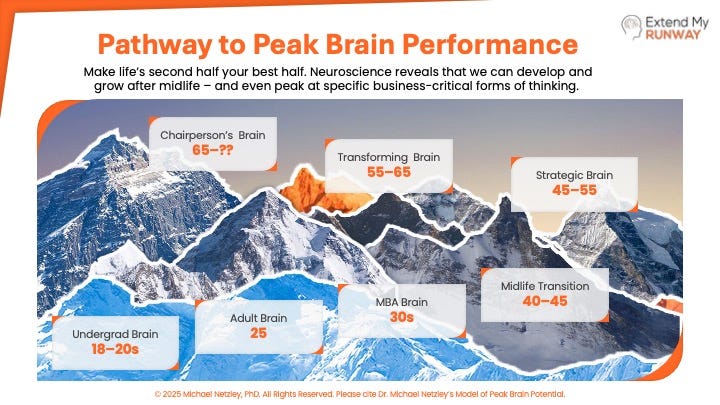
Again, this image is just a teaser. It aggregates neuroscience from top universities and journals, offering us a map for building cognitive strengths at midlife and beyond.
Age is just a proxy. We will focus on the cognitive abilities, not the numbers.
I will unpack the science in the upcoming four parts of this series. This summer, a feature article in I by IMD magazine will unpack the model, too.
Let’s Be Clear
Myths and pretty marketing stories can tempt you astray.
You have potential, but it won’t just magically emerge over time.
Generational labels explain nothing (it’s astrology, not science).
You’re not wise simply because you're older (“…but wouldn’t it be nice” - Brian Wilson tribute).
No superpowers are coming (sorry, Avengers and Cocoon are entertainment).
What most of you can have is a higher-performing brain, better quality of life, and, if you so choose, a longer or encore career.
Each begins with (re)training your brain at midlife or before.
In the next four newsletters, I’ll reveal the pathway step by step.
What’s Coming in the Pathway Series
Part 2: Discover How Your Brain Gets Better with Age
Part 3: Refresh Your Identity and Rewrite the Story You Tell Yourself
Part 4: Apply Behavioural Science to Take Small Steps that Create Big Change
Part 5: Discard the Myths and Misinformation—Stick to the Science
You Can Make Life’s Second Half Your Best Half
Whether you’re navigating retrenchment, relationship shifts, or wondering what’s next — start with your brain health and performance.
Science gives you more signal, less noise.
And to close with the line that captures the spirit of this journey, I’ll return to The Boss and his anthem Thunder Road. (a personal favourite)
“I believe in a promised land.”
– Bruce Springsteen
I created Extend My Runway Pte. Ltd. and Thrive After 45 to help you case your promised land. (Thank you again, Bruce!)
Let’s begin.
Hot Off the Press: Uncertainty Can Strain Your Brain, and Here’s What to Do About It
Learn three immediately actionable tips for optimising brain performance when stressed by uncertainty. My latest article was just published in I by IMD magazine.
Need a free 3-month subscription to the magazine?
Head over to the Thrive After 45 chat on Substack. There, you will find a QR code giving you complimentary access.
My gift to you.

News: Today’s Must-Read Ageing Brain Article
Here’s the headline and hyperlink (you may have to register).
Who are you calling over-the-hill? The truth about brain ageing
It’s not necessarily correct that our cognitive skills decline as we get older
It’s a short read with great points.
The research methods are different, using very traditional constructs for the scientific testing that differ from what I refer to in Pathways to Peak Brain Performance.
Still, the point remains - we can excel later in life than we previously believed.

Act Now: Behavioural Tip of the Week
Here’s one small action that can help deliver measurable brain gains.

Thank goodness I read this first thing in the morning before doom scrolling. What a great way to start the day with this great content, Mike! Love it!